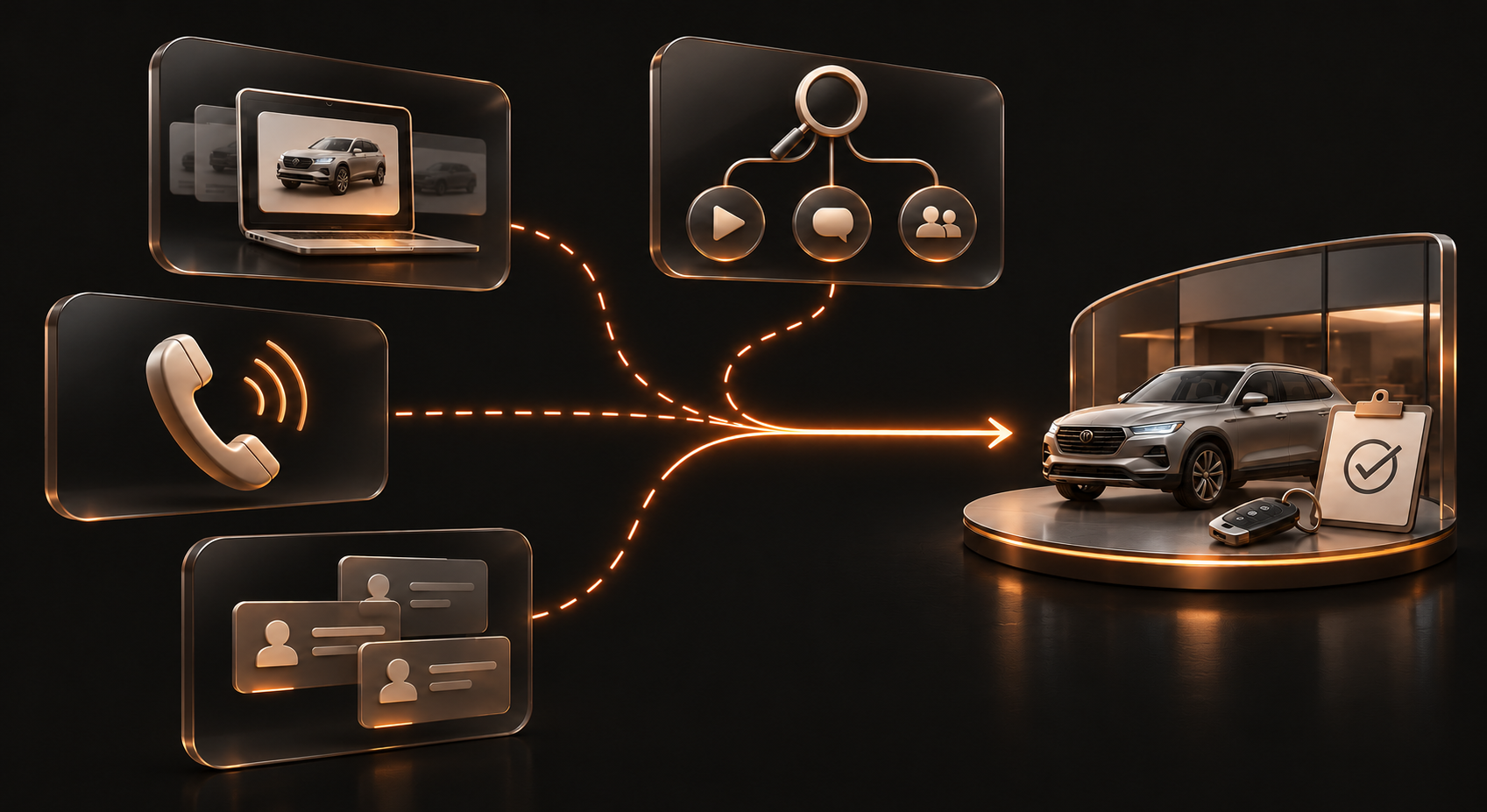
Every dealership is capturing leads. The real question is whether they understand the journey of each lead with proper end-to-end attribution to allow smart decision making with their valuable marketing spend. Before an agentic system can act on their data, that data has to be complete. And for most dealers, it isn’t.
Even more damaging, most of those dealerships don’t realize they’re missing key information to begin with. When every part of the equation is a mystery, solving it is nearly impossible. As Kraig Atkins, Director of Marketing at Lewis Automotive Group, puts it, "You don’t know what you don’t know and that’s a problem. We need the right information all the time."
Agentic Business Intelligence (ABI) helps by both analyzing the data you have and uncovering the data you’re missing. OneVision.ai is built around four primary blind spots that silently erode attribution, distort ROI, and leave your sales strategy flying half-blind.
Blind Spot #1: The Third-Party Marketplace Illusion
“I have all the data in the world,” says Chad Simon, Senior Integrated Marketing Manager of Cochran Automotive. “None of it helps if I can’t track it to a sale.” Platforms like AutoTrader, Cars.com, and CarGurus present themselves as lead sources — and they are, partially. When a shopper fills out a form on one of those sites, that lead flows into your CRM and the platform gets credit. But more than half of those same shoppers also visit your dealership’s website directly before making contact. That traffic arrives as referral traffic, and once it hits your site, standard tracking loses the thread. The shopper calls, chats, or submits a form on your site — you get the sale, but the actual attribution is never resolved through the transaction. You can’t accurately measure the third-party marketplaces against CPL or CPS. That leads to incorrect budget distribution, overspending for sources, and being unable to negotiate a better deal.
True ABI – OneVision – closes this loop by following the customer journey across both touchpoints, matching referral visits back to closed sales and giving you a true picture of what each third-party platform actually delivered.
Blind Spot #2: The Google and Facebook Black Box
Paid search and social advertising have the same attribution problem, only amplified. Unlike third-party marketplaces, Google and Facebook don’t capture a form that flows directly into your CRM. Some providers offer call tracking numbers and partial conversion data, but roughly 80% of the buyers these campaigns influence are invisible to standard reporting. You know the campaigns are running. You don’t know which of your ten or twelve active search campaigns actually sold a car.
That gap makes campaign optimization almost impossible. An agentic system tied to verified sales data can connect campaign performance to actual transactions — so you stop optimizing for clicks and start optimizing campaigns that sell cars.
Blind Spot #3: Call Tracking That Doesn’t Track
Many dealerships use Dynamic Number Insertion (DNI), which automatically assigns a unique phone number to each traffic source. A shopper who found you through AutoTrader calls a different number than one who came from Google. In theory, every call gets attributed. In practice, those call logs pile up in a tracking system that nobody has the bandwidth to reconcile. The raw data exists, but it’s never properly organized by source, never matched back to outcomes, and never used to inform budget decisions. It’s a sophisticated system producing unread reports.
ABI automates the reconciliation, connecting call data to lead sources and, ultimately, to sales — so your call volume becomes actionable intelligence attributed to the correct source rather than archived noise.
Blind Spot #4: The Fragmented CRM
Your CRM is only as useful if the data inside it is properly parsed and matched. Third-party vendors like AutoTrader submit multiple lead types — a financing inquiry, a trade-in form, a specific vehicle request — as separate entries under separate source labels. The result is a CRM full of duplicate and fragmented records from the same vendors, none of them bucketed together. For example, you can’t see AutoTrader’s or CarGurus’ true lead volume or cost-per-sale because its contribution is scattered across four different line items.
OneVision normalizes and consolidates those entries, so each source gets a single, accurate record. Combined with transactional sales matching, you can finally see what each vendor actually costs per car sold — not just per lead submitted.
What Resolving the Blind Spots Makes Possible
Once your data foundation is complete and accurate, ABI can do what it’s designed to do: act on it. Every salesperson’s performance becomes legible across lead type, channel, and vehicle — revealing not just who closes the most deals, but who handles internet leads versus walk-ins, and how much marketing spend was behind each result. Budget decisions stop being gut calls and start being data-driven moves.
Tools like OneVision.ai bring more than just cleaner data. You’re eliminating the distortions that have been quietly skewing every decision you’ve made about where to spend, where to cut, and who to trust with your best leads. That’s the foundation an agentic system requires — and the competitive edge it delivers.